
Pallet racking should have an expert inspection by a technically competent person at least every 12 months, regular visual checks by a trained member of your own team in between, and any damage reported the moment it happens. That is the approach set out in the HSE’s guidance for warehouses, HSG76.
The short answer
- Immediately: report any damage or knock as soon as it happens.
- Regularly, often weekly: a visual check by your person responsible for racking safety (PRRS).
- At least every 12 months: an expert inspection by a technically competent person.
What Do the HSE Racking Inspection Guidelines Say?
No single law names racking inspections, but racking is work equipment, so several pieces of legislation apply. The main ones are the Health and Safety at Work etc. Act 1974, the Management of Health and Safety at Work Regulations 1999 and the Provision and Use of Work Equipment Regulations 1998 (PUWER). PUWER requires work equipment that can deteriorate and become dangerous to be inspected at suitable intervals by a competent person.
The HSE’s guidance HSG76, Warehousing and storage: a guide to health and safety, explains how to meet those duties for racking. It recommends three types of inspection, taking damaged racking out of use until it has been repaired, and keeping a record of inspections, damage and repairs.
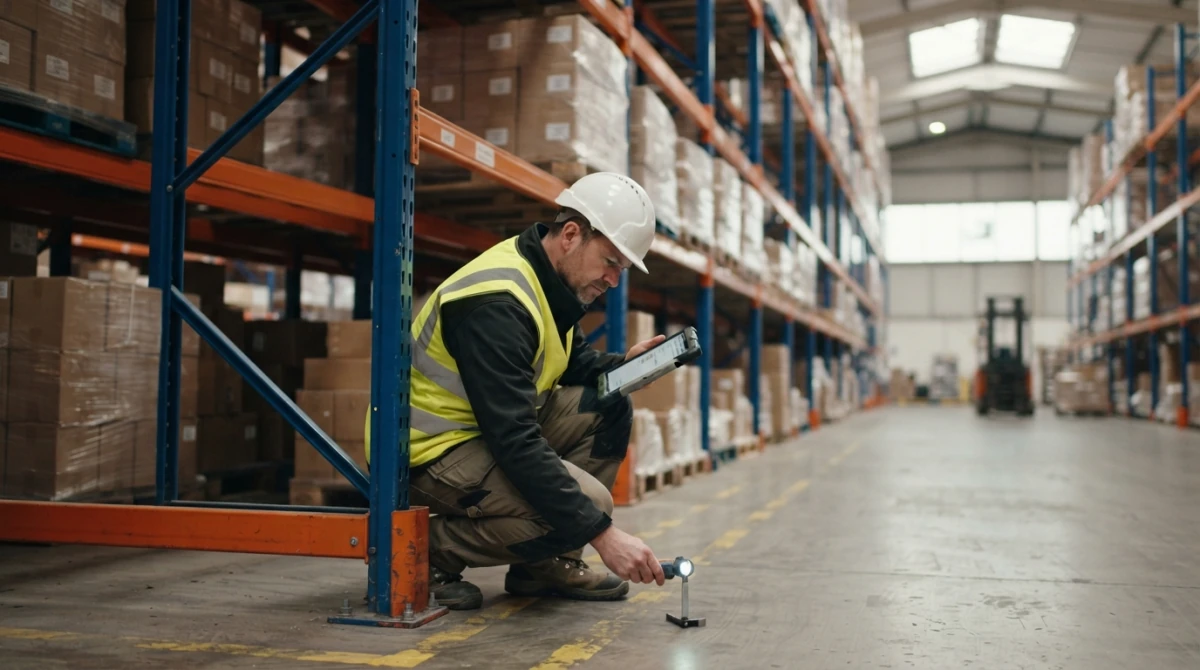
Racking Inspection Frequency at a Glance
| Inspection | Who does it | How often | What it covers |
|---|---|---|---|
| Immediate reporting | Anyone working near the racking | As soon as damage happens | Any knock, bend or missing part, however minor |
| Visual inspection | Your trained PRRS | At regular intervals, often weekly | A walk round from ground level, recording new damage, missing safety pins and overloading |
| Expert inspection | A technically competent person, usually from outside your business | At least every 12 months | Every run in detail, with each defect graded in a written report |
If you have a mezzanine floor or shelving alongside your racking, include it in the same schedule.
When Should Racking Be Inspected More Often?
Twelve months is the maximum interval for the expert inspection, not a target. Your racking may need checking more often if:
Busy sites
Heavy forklift traffic and fast stock turnover mean more knocks.
Harsh conditions
Cold stores, damp buildings and corrosive environments, such as some chemical and pharmaceutical sites, wear steel faster.
After an incident
Any significant impact, collapse or near miss calls for a check before the area is used again.
After changes
Moving beam levels, adding bays or relocating the racking changes how it carries load.
Used racking
Check second hand racking before it goes up. See how to inspect racking before buying.
Keep a Record of Every Inspection
HSG76 recommends keeping a record of inspections, damage and repairs, for example in a logbook. Your insurer may also ask to see it. For each defect, record:
- Date and inspector: when it was found and who found it.
- Location: the aisle, bay and level.
- Defect and grade: what is wrong, and whether it is green, amber or red.
- Action: what was done, such as the bay unloaded or the part replaced, and when.
What to Do Between Inspections
- 1Report it: make it easy for drivers to report knocks without blame, so nothing goes unrecorded.
- 2Unload and isolate: take damaged bays out of use until they have been assessed.
- 3Repair properly: replace damaged components with matching parts through our racking repairs service.
Our guide to the signs of racking damage shows what your PRRS should look for on each walk round.
Small knocks add up
Not every driver reports what feels like a minor bump. Left alone, several small dents combined with overloading can weaken a frame enough to fail, which is why the regular checks matter as much as the annual inspection.
Book Your Annual Racking Inspection
Our pallet racking inspections check every run and grade each defect in a written report. Quotes are free.